I am pleased to announce a fresh upload of data to Mill Marginalia Online. The roughly 2500 new examples of marginalia include all those found in the works of both James and John Stuart Mill. Most of these were clearly made by JSM himself, with an eye towards future republication, whether in Dissertations and Discussions or in subsequent editions of A System of Logic or Principles of Political Economy. Although nearly all are accurately noted in the University of Toronto Press’s edition of the Collected Works, being able to see Mill’s careful revision of his own prose in his own hand lends a certain immediacy and vitality to these moments of textual history.
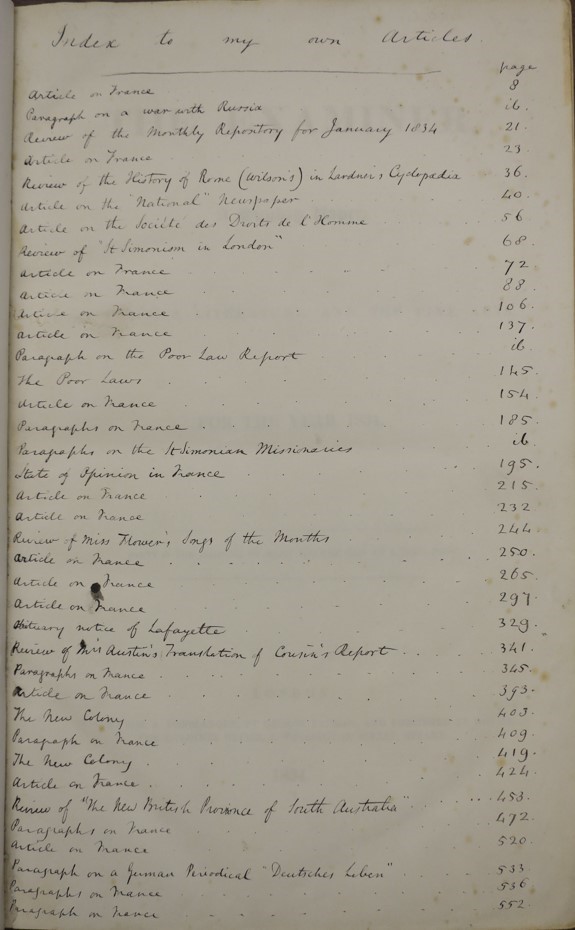
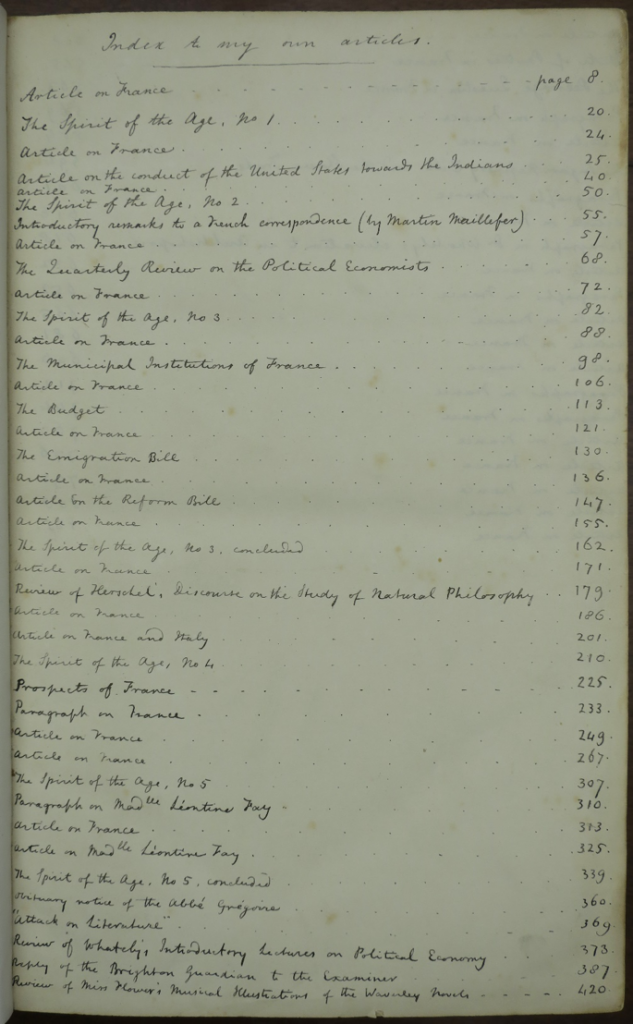
The front flyleaves of bound volumes of The Examiner from 1831, 1832, 1833, and 1834 provide a particularly clear example of Mill’s curatorial impulses towards his own publications, written in his most legible hand. The following appears in the 1834 volume:
Front flyleaf, The Examiner, 1834
Obviously proud of his relatively early work in the newspaper, Mill has gone out of his way to record every paragraph, notice, and article that he contributed. Some of the items listed seemed to him significant enough to revisit in the margins, and this latest set of images captures every copyedit, revision, renumbering, and doodle that he made.
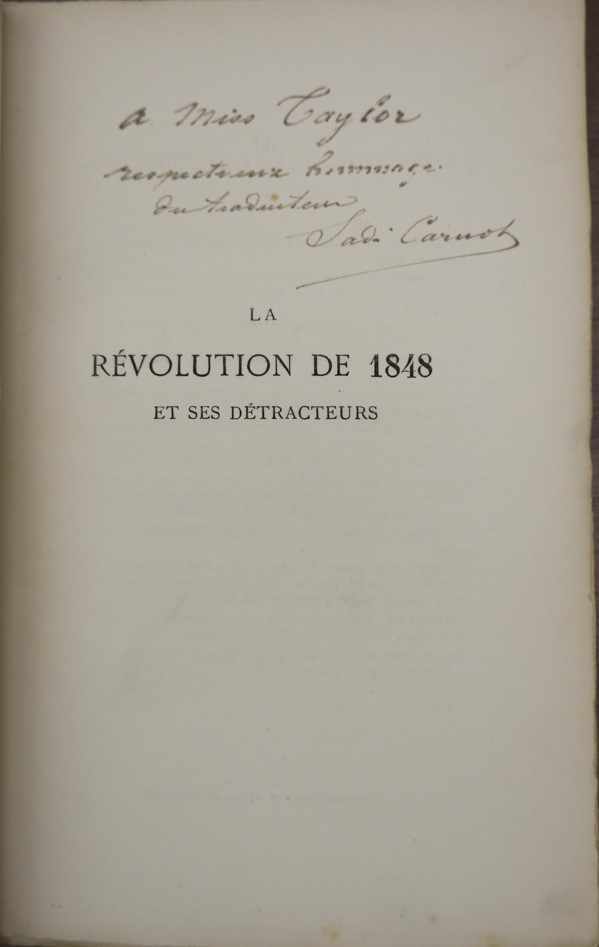
Also present are translations of Mill’s work in French, Italian, and German, most with inscriptions from their respective editors. These include volumes received after Mill’s death, at which point the inscriptions shifted their addressee to Helen Taylor, Mill’s stepdaughter, late-career amanuensis, and guardian of his intellectual legacy. See, for instance, the half-title page of Said Carnot’s 1875 French translation of La Révolution de 1848 et ses Détractures:
Half-title page, La Revolution de 1848 et ses Detractures
Most of the pages in this book remain uncut, indicating that for all Carnot’s “respectful homage,” Helen Taylor did not read it. She did, however, preserve it among Mill’s books, making it available for digitization today.
My thanks to Patrick Motley for his perseverance in uploading this new material, to Riley Hines for her meticulousness in looking over the data, to Kaitlin Wright for making the original transcriptions, and to everyone involved with the project for their patience and good humor in the midst of global anxiety.
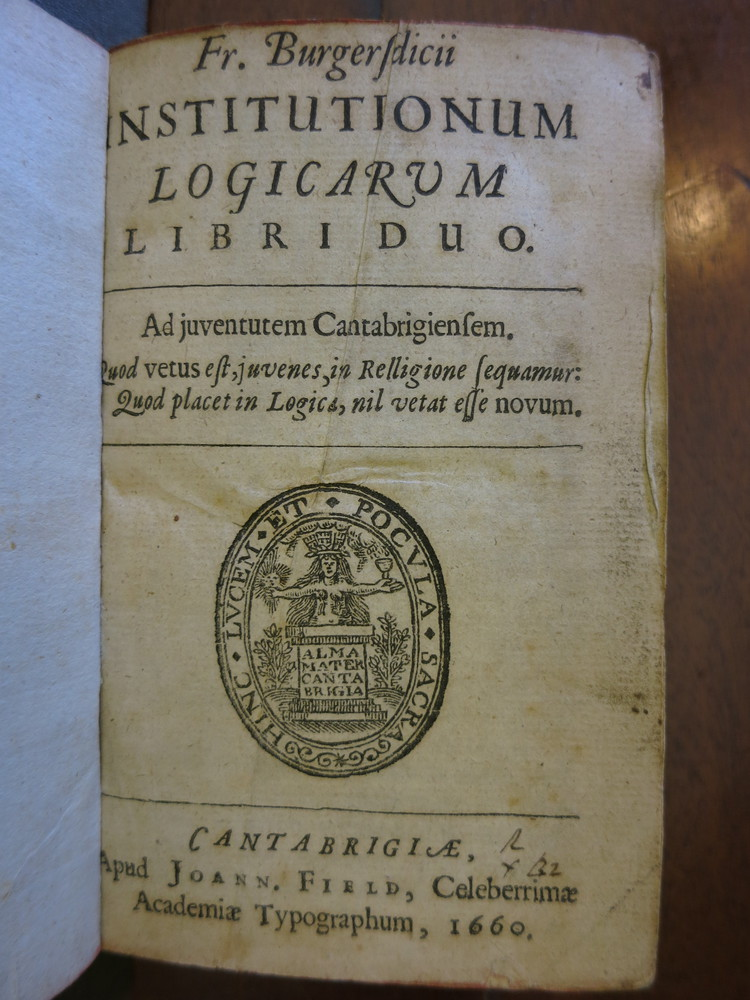
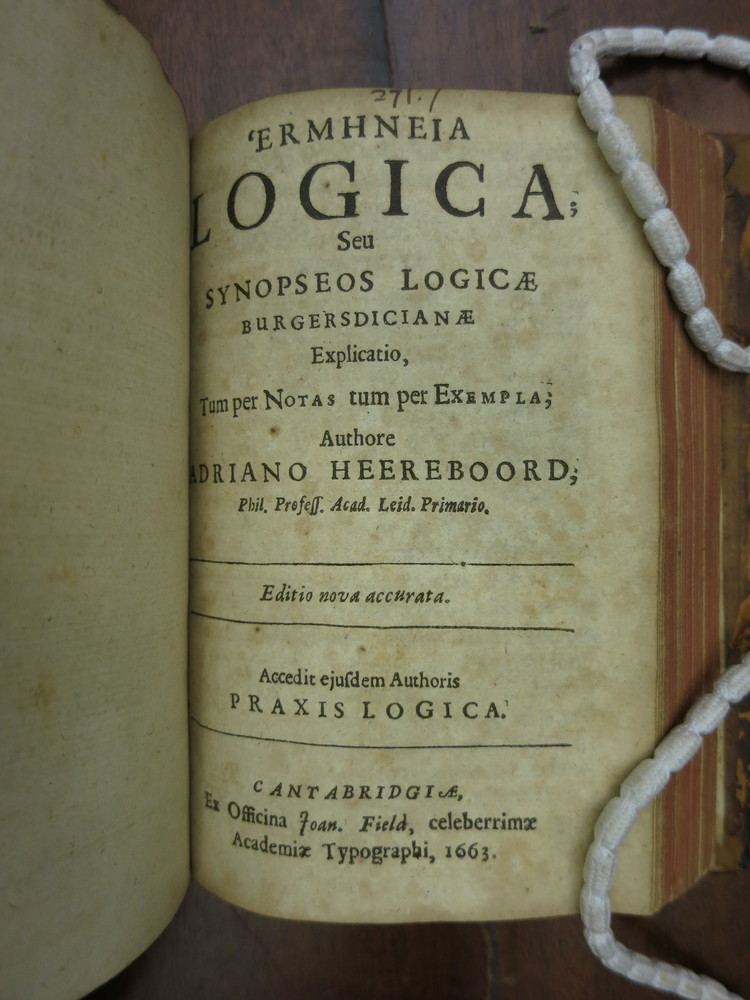
My third and final 2020 publication was co-authored with my co-PI, Emma Wilson, and appeared in a special issue of Nineteenth-Century Prose dedicated to Mill. It focused on the volume catalogued as Francis Burgersdicius’s Institutionum Logicarum, which is actually two books printed together, Dutch schoolman Franco Burgersdijk’s textbook Institutionum Logicarum, published in 1660, and his successor Adriaan Heereboord’s Hermēneia Logica, published in 1663:
Title Page of Franco Burgersdijk’s Insitutionum Logicarumtitle page of Adriaan Heereboord’s Hermeneia Logica
Each contains an independently paginated preface and main text, with Institutionum Logicarum featuring 24 pages of prefatory material and 357 pages of main text, while Hermēneia Logica offers 6 pages of prefatory material and 311 pages of main text. With roughly three-quarters of the collection now surveyed for handwritten additions, one half of which have been photographed, and one quarter transcribed and uploaded, I can say with some confidence that the book contains the second largest number of individual examples of marginalia of any single volume. In all, 351 of its pages contain at least one mark or annotation, with 1568 total instances.
Over one-third of this total is represented by 576 examples of neatly handwritten numerals. Some of these examples contain multiple numbers separated by periods, however; when these numerical chains are broken into their constituent links, the total quantity of marginal numbers increases to 611. These can be found in three of the four independently numbered sections of Institutiorum Logicarum: 21 in the first set of prefatory pages; 251 in Burgersdijk’s main text; and 339 in the main text of Heereboord. The numbers appear in two forms, with and without a decimal tenth added (i.e., 19 and 19.1). Since when multiple individual numbers appear together in the same annotation they are also separated by periods, this convention only added to the marginalia’s initial inscrutability.
Ultimately, Emma and I were able to discern that the more than 600 handwritten numbers in Burgersdijk’s Institutiorum Logicarum provide an elaborate system of marginal cross-references. Just under 95% (580 of 611) of all numerical annotations in the book lead one to corresponding annotations on the pages referenced by the original numbers. Numbers with a decimal tenth added to them lead one to pages in the other, independently paginated portion of the main text.
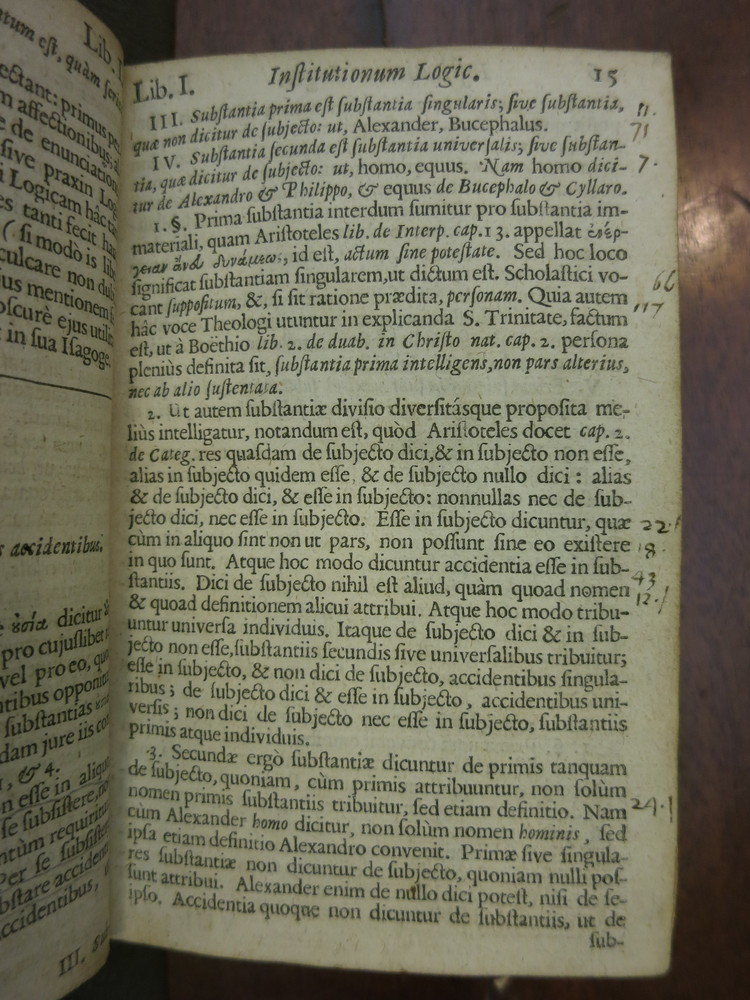
p. 15 of JS Mill’s personal copy of Burgersdijk, with hand-written numbers in outer margin
Thus, page 15 of part one, pictured above and authored by Burgersdijk, includes, from top to bottom, the handwritten numbers 11, 71, 7, 66, 117, 22.1, 18, 43, 12.1, and 24.1. Similarly, pages 11, 7, 66, 117, 18, and 43 of part one contain a handwritten “15” in the margin, whereas pages 22, 12, and 24 of part two, authored by Heereboord, all feature “15.1”; moreover, each of the pages referred to by page 15 also contains additional numbers that, on the basis of other subjects, lead one to further pages.
Of the remaining 31 numbers for which there are no apparent corresponding pairs, 21 appear in the prefatory pages of Burgersdijk’s half of the volume. Here, they provide page numbers, odd numbers only, in the top corner of pages that are otherwise only identified by their section headings (i.e., “Dedicatio” or “Præfatio ad Lectorem”), allowing for marginal cross references between these now-numbered early pages. Alas, the final ten numbers resisted all of our efforts to decode them.
Nevertheless, sorting out the function of 601 of the 611 marginal numbers allowed us to compare the printed text adjacent to Mill’s handwritten numbers, concentrating for the purposes of our article on those appearing in Burgersdijk’s half of the volume. In so doing, we discovered that, even in his tweens, Mill was already embarking on the intellectual trajectory that would ultimately result in his own System of Logic (1843). His marginal numbers allowed him to move quickly between, to cite only a few examples, 1) similar passages exhorting a sound logical education as the basis for the correct and upright running of a nation, 2) Burgersdijk’s hierarchical classification of logicians into a “first,” “second,” and “third” class, as well as other ways of structuring learning about logic, 3) the Dutchman’s definition of logic, 4) his enumeration of the four instruments of logic (definition, division, syllogism, and method), 5) his connection between the practice of logic and the development of lasting intellectual habits, and 6) his taxonomy of causes, including his differentiations between “proegumenic” and “procatarctic” causality.
Constructing this dense network of marginal numbers was, undoubtedly, an enormous amount of work. It is also work that would need to be done while the book was fresh in one’s mind, perhaps with the aid of now-lost handwritten notes, as the range of cross-references spans the entire volume, in 80 instances pointing out corresponding passages in the separate treatises written by Burgersdijk and Heereboord, respectively. Whenever the numbers were added—and this is a chronological detail that we are likely never to be able to pinpoint—they were a significant addition to a text already crowded with evidence for Mill’s close engagement and sustained dialogue.
In April 2020, the second of three new publications on Mill’s marginalia appeared in ILCEA4, the Revue de l’Institut des langues et cultures d’Europe, Amérique, Afrique, Asie et Australie, which put out a special issue on international Digital Humanities research (https://journals.openedition.org/ilcea/8568). My contribution, “Handwritten Marginalia and Digital Search: The Development and Early Research Results of Mill Marginalia Online,” sought to introduce the journal’s international audience to Somerville’s John Stuart Mill Collection, the ongoing collaborative effort to digitize its marginalia, and Mill’s specific marginalia in Alexis de Tocqueville’s De la Démocratie en Amérique (1835-40) and Auguste Comte’s collected works, including Cours de Philosophie Positive (1830-42) and Système de Politique Positive (1851-54).
The scope of this article thus allowed me to acknowledge the important previous work undertaken to assemble Charles Darwin’s Library and Melville’s Marginalia Online, both of which were models for Mill Marginalia Online. I was also able to recognize two of the granting bodies supporting our digitization efforts, the NEH and the Gladys Krieble Delmas Foundation, to talk about the exciting early discoveries made in Mill’s library, and to attempt a technical description of the project suitable for non-technical readers.
The specific marginalia in Tocqueville and Comte’s works was selected for its importance in nineteenth-century intellectual history and to appeal to the journal’s many French readers. Mill also annotated very differently in response to Tocqueville and Comte. The former prompted a relatively small number of significant verbal comments, often skeptical, in response to his then-friend’s analysis of America’s great social and political experiment in representational democracy and over-determining expressions of public opinion. These are in contrast to his published encomiums concerning Democracy in America. Mill’s much greater number of marks in Comte’s works are, as detailed in my previous post, much briefer and appear undertaken to support his very public critique of Comte’s intellectual legacy.
Mill arguably did more than anyone else to introduce his countrymen to the ideas of both Tocqueville and Comte. His reviews of 1835 and 1840 elevated Tocqueville’s concerns about “the tyranny of the majority” and the tension between liberty and equality to the forefront of subsequent debates over the character of England’s emerging democracy. And, as he himself recognized in his Autobiography and as subsequent historians of sociology have endorsed, Mill “contributed more than any one else to make [Comte’s] speculations known in England” (CW I.271). However, as the marginalia in his personal copies of both men’s work attests, Mill initiated this intellectual leavening of British intellectual history with radically different methods of reading and annotation.
There is nothing quite like personnel changes followed immediately by a global pandemic to upend one’s original plans for project updates, whether of the technical or narrative variety. However, with a new upload of data drawing ever closer, I am pleased to welcome Riley Hines and Patrick Motley to Mill Marginalia Online. Riley replaces the intrepid and invaluable Kaitlin Wright, who has graduated from UA, as the project’s newest research assistant. She has been eyeballs deep in Mill’s Classics collection since August 2020, deciphering marginalia in English, Latin, and Greek, while also discovering a new form of underlining, which we hope to feature in a future upload and metadata upgrade. Patrick replaces James as the Alabama Digital Humanities Center’s IT Technical Specialist; although, James has generously remained only a consult away as Patrick settles into his new role.
Unfortunately, travel restrictions brought on by the pandemic have prevented me from planned visits to the friendly confines of Somerville College and the John Stuart Mill Collection for the collection of fresh photographic data. Not altogether idle, however, I have produced a number of articles about Mill and his marginalia that are beginning to make their way into print.
Appearing first, at the beginning of 2020, was “Mill, Comte, and the Literature of Sociological Critique,” the first chapter of The Socio-Literary Imaginary in 19th and 20th Century Britain: Victorian and Edwardian Inflections (Routledge). This essay seeks to place the 917 marks and annotations found on 685 pages of Mill’s copies of nine different titles by French positivist and inventor of the term “sociology,” Auguste Comte, in the context of both their decades’ long relationship and Mill’s statements about the complementary functions of Art and Science in his System of Logic (1843). In a nutshell, although Mill was initially impressed by Comte’s scientific achievements—in fact, the first edition of the System of Logic was primarily responsible for introducing those achievements to the English-speaking world—he became progressively more suspicious about Comte’s social prescriptions and more impatient over the Frenchman’s bizarre obsessions, with the number thirteen for example, finally offering a devastating critique of both on the basis of both Science and Art in Auguste Comte and Positivism (1865).
The marginalia scattered unevenly throughout Comte’s works, over 95% of which are nonverbal marks, record Mill’s research for this later published work. They also suggest, indirectly, that the only very lightly marked and annotated copy of Comte’s Cours de Philosophie Positive (1830-42) may not be the original edition that Mill recorded reading with great assiduity in his letters from 1837, 1838, and 1841. Perhaps the London Library holds this unrecognized treasure of marginal proportions!
I write to welcome Anne McDivitt and James Michelich to Mill Marginalia Online. Anne is the new Director of the University of Alabama Digital Humanities Center and James is the Center’s new IT Technical Specialist. Both rushed to learn the technical details requisite to upload the latest tranche of data, collected during my March 2018 trip to Somerville and transcribed with the indefatigably keen eye and nimble fingers of Kaitlin Wright. Many thanks to the three of them for their prodigious labors.
The results of all their efforts are now available for searching: slightly more than 3600 new examples of marginalia, including the now-complete transcription of Mill’s books on law; the Mill family bible, a rare edition made unique by hundreds of handwritten additions; the published works of James Mill; and a large number of books, many in multiple editions, by John Stuart Mill, some with evidence of his editorial hand. Of the last grouping, the meticulous corrections made by Mill in the French edition of his On Liberty, translated by Dupont-White, indicates his great desire to be correctly understood by those in his second home.
Collectively, this new data represents a substantial addition to Mill Marginalia Online, which has now digitized nearly 25% of all marginalia in Mill’s library. Corrections, refinements, and technical updates are also ongoing, so please check back now and again to see what’s new.
I just concluded a highly productive visit to the always hospitable Somerville College (special thanks to Anne, Sue, Matthew, Kate, Jane, and Beth), with the following quantitative results:
1 Tea with John Stuart Mill, at which there were . . .
4 presenters: Andrew Dalkin, speaking on Mill’s often downplayed commitment to his day job at the British East India Company; Bethany Slater, reporting on the state of the marginalia census, 42,000 items and counting, as well some surprisingly well-preserved botanical specimens stored within books that otherwise received very little attention from Mill; David Howell, showing early analyses of the over one terabyte of hyperspectral imaging data amassed so far; and myself, surveying the multitude of media recently featuring John Stuart Mill, as well as enumerating updates already made to and planned for Mill Marginalia Online – the latter one day to include the future processing of . . .
9819 photos, of pages from . . .
220 volumes, which together accounted for . . .
105 separate book titles, and featured between . . .
7216 and 7321 individual examples of marginalia (the precise number will depend on the final transcriptions).
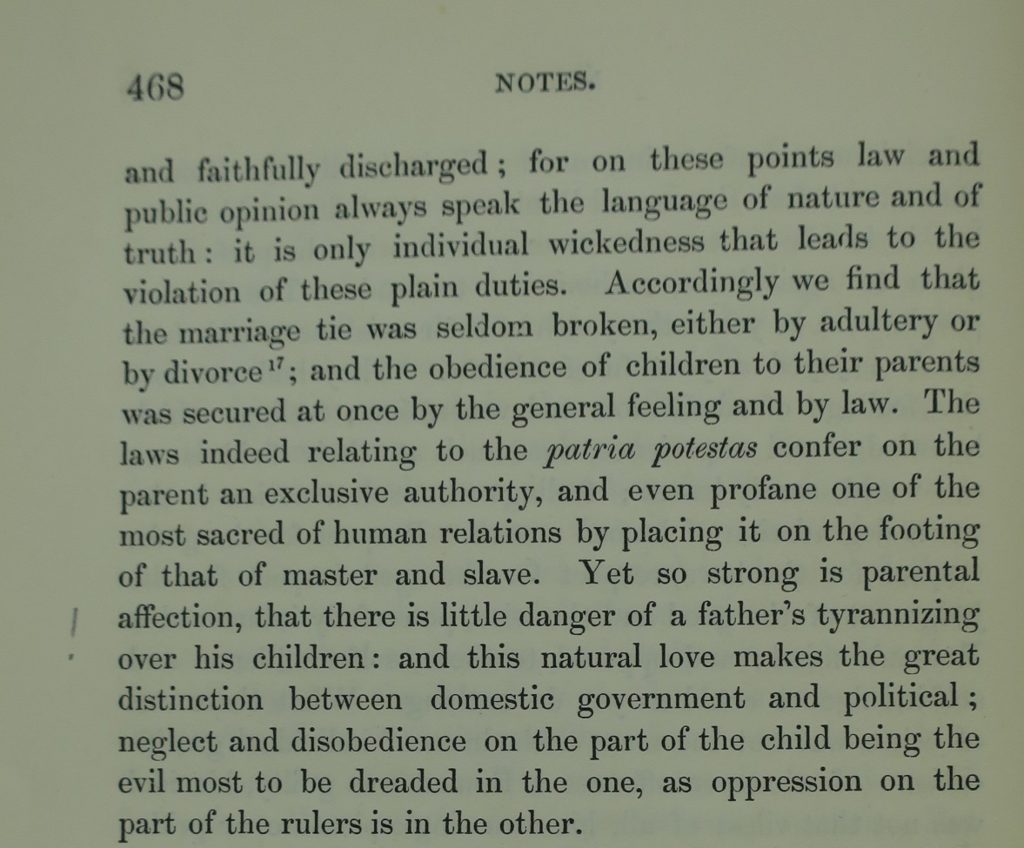
Qualitatively, there were also myriad exciting finds. In addition to those featured in my previous posting (A Fortnight in Oxford), I offer, first, what may be the most eloquent nonverbal mark discovered so far, in Thomas Arnold’s three-volume History of Rome:
James Mill had been gone for over seven years by the time volume three of Arnold’s History was published, but even so it seems his “natural love” had not been forgotten.
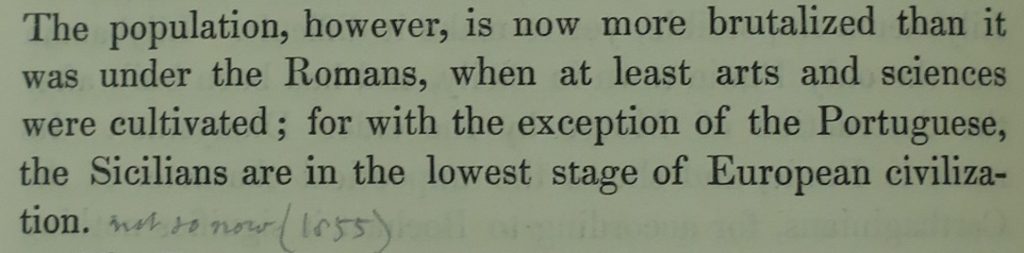
Second, the 1844 English translation of German historian B. G. Niebuhr’s own History of Rome yielded a rare, because precisely dated, annotation on page 130 of volume 1:
This comparative observation on the progress of civilization in Sicily provides both an example of Mill’s hand from 1855, and an unusually specific record of what he was reading in his 49 year.
My most recent data-gathering trip to Oxford has seen Burgersdijk’s Institutionum Logicorum dethroned as the single volume with the greatest number of individual examples of marginalia. Appropriately, the neo-Aristotelian has been supplanted by Aristotle himself, specifically a 1621 Frankfurt edition of Aristotelis de Anima Libri Tres, Graece et Latine, with slightly more than 1800 total marks and annotations. These include some at-this-point inscrutable date and number combinations, like this one from p. 7:
Whether September 29th was the date Mill read this work while studying with his father, or whether its significance lies elsewhere is difficult to determine. Even more unclear is the significance of the number that follows, which cannot correspond to one of the only slightly more than 400 pages in the volume. Moreover, there are no marks or annotations on p. 705 of any other edition of Aristotle’s work held in Somerville’s Mill Library. And every one of the date and number pairings in the bilingual Aristotelis de Anima Libri Tres adheres to this format and includes a similarly large number.
Also discovered on this trip is what promises to be the volume with the largest proportion of verbal annotations to nonverbal marks, George Grote’s twelve-volume History of Greece. Mill reviewed Grote’s History in 1846 and 1853, but he appears to have read the volume with the additional purpose of helping Grote to revise for a second edition. Hundreds of pages include meticulous commentary, including corrections to Grote’s Greek quotations, detailed observations on Greek topography, suggestions for clarifying Grote’s prose through the elimination of overly-vague words and phrases, and, of course, close engagement with Grote’s historical narrative and ideological implications. My rough estimate, based upon the five volumes I have already photographed, is that annotations outnumber marks roughly four to one; and each volume features well over one hundred annotations, many quite lengthy. The following close up on the outer margin of p. 417 of volume 3 provides a glimpse of the care with which Mill approached his reading:
Anyone who has written even a single volume would be grateful for this level of close attention, and Mill keeps up the pace for twelve volumes! This despite Grote’s rather embarrassing slip in the handwritten dedications to volumes three and four (that from the title page of volume four is below):
Note the spelling of Mill’s middle name. Hardly a strategy for endearing oneself to a reviewer, even when accompanied by “faithful regard and friendship,” but Mill seems not to have let it bother him. He didn’t even note the mistake in an annotation.
As mentioned in my previous posting (Evidence of Mill’s Reading and of Reading Mill), among the books held in section D of the Mill Library are four bound volumes of article offprints. Nearly all operating at a loss, nineteenth-century periodicals tended to economize on paper by allowing no dead space between articles, which means that Mill’s offprints sometimes start in the middle of a page with the final paragraphs of the preceding article above, or end with enough room for the following article to commence at the bottom of the final page. If they begin on the even-numbered verso side of a given sheet, then the recto side of the first page of the offprint features the last full page of the earlier article; and, if they end on the odd-numbered recto side of a sheet, then the verso side of the last page of the offprint usually includes the first full page of the next article.
All of which can add up to a substantial amount of other writers’ text attached to the beginning, ending, or both of a review essay written by Mill. At some point, much of this extraneous verbiage was struck through in heavy black ink and then papered over for good measure, leaving Mill’s printed words in sole possession of the field represented by the bound volumes in section D. The question of who did this and when remains open, and is sometimes complicated by what remains visible still underneath the pasted-in sheet.
Often, it is possible to discern Mill’s hand-written record of the original publication details of his article through the covering paper, as with the following annotation at the top of the printed page immediately prior to an article written by Mill for the Monthly Repository in February 1833, and found in the JSM 1832-4 bound volume:
The presence of Mill’s hand at the top of the recto face of the first sheet of the article suggests that he was not particularly bothered by the layout consequences of early Victorian periodical publication. Unless he came to believe that having the page to himself was more important than accurately recollecting the original publication details, then, it seems unlikely that he papered over his own annotation.
An even more problematic instance of the desire for printed order appears in the London and Westminster Review bound volume at the end of Mill’s “Radical Party and Canada,” which because it ends on p. 533, features a back side with another author’s typescript. Predictably, this final verso face has been struck through and papered over:
Once lit from behind, however, it becomes clear than this decision was more than just an aesthetic one. In fact, the entire verso side of the essay’s final sheet is covered in the most legible version of Mill’s own script:
Thus, whoever covered the back side of the final page of “Radical Party and Canada” thought the printed text more important than the handwriting, which, when fully transcribed (thank you RLP!), turns out to be the fair copy of the beginning of Mill’s next LWR article, a review of William Ware’s Letters from Palmyra (1838):
Art. V. Letters of Lucius Manlius Piso from
Palmyra to his Friend Marcus Curtius at Rome
Now first translated and published 2 vols 12mo
New York: 1837
Speaking of the difficulties which in
America retard the formation of a vigorous
and original National Literature and
of the copies and imitation mere echoes of
the inspired voices of the Old World, which
must in the mean time be accepted as great
things until a greater appear. Miss
Martineau says:*
“I met with one gem in American literature
where I should have least expected it in
the ‘Knickerbocker’ a New York Monthly
Magazine.
Last spring a set of papers
began to appear, called ‘Letters from
Palmyra,’ six numbers of which had been
issued when I left the country. I have
been hitherto unable to obtain the rest
but if they answer to the early portions
there can be no doubt of their being
shortly in everybody’s hands in both countries
Society in America vol iii p 216
To most modern scholars, it will probably seem extraordinary, even outrageous, to privilege reusable and much reproduced type over unique and previously unknown script.
Less shocking, but perhaps equally interesting, is what the presence of Mill’s fair copy for one article on the verso side of the final page of another article suggests about his valuation of his own offprints. Far from the sacred record of previous publication (how many of us have a shelf/box/drawer devoted to our own in-print acceptances), at least the back side of Mill’s LWR piece on the complex social and political circumstances of British Canada was valuable only as scratch paper, as a surface on which to work out what was not even an original system of logic or updated theory of political economy or impassioned apology for individual liberty, but instead a laudatory review of an American writer’s imitation of epistolary correspondence in Antiquity.
One might well wonder what Mill would have thought of the decision to bind his assorted offprints into book form in the first place, much less to attempt – happily unsuccessfully – to excise all signs of their original periodical context and attendant hand-written text.
Now nearing the end of my sixth data-gathering trip to Oxford, I have just completed photographing one third of the John Stuart Mill Library. Which is to say that I have finished section D (of L), in which are shelved the numerous editions – American, English, French, German, Greek, and Italian – of Mill’s published works. Also in D are select runs of the London Review, the Westminster Review, and the Examiner, as well as four bound volumes of article offprints, three arranged by year of publication and one devoted exclusively to pieces from the London and Westminster Review during the period (1836-1840) in which Mill was a prolific contributor as well as the de facto editor.
As one might imagine, many of these books and articles testify to Mill’s meticulousness as an editor of his own works. The first edition of his System of Logic (1843), for instance, features a number of the editorial corrections and sentence-level revisions that appear in later editions, and that were subsequently documented by John Robson and his team at Toronto. This is also the case for the first edition of Mill’s Principles of Political Economy (1848), and for many of the essays that he would go to feature in Dissertations and Discussions (1859 and later).
Much to the benefit of those who would become his later scholarly editors, Mill was impressively assiduous when it came to documenting his early newspaper writings. Four of the five volumes of the Examiner held at Somerville contain painstaking lists like this one, handwritten onto the front flyleaf of the 1831 volume by Mill himself:
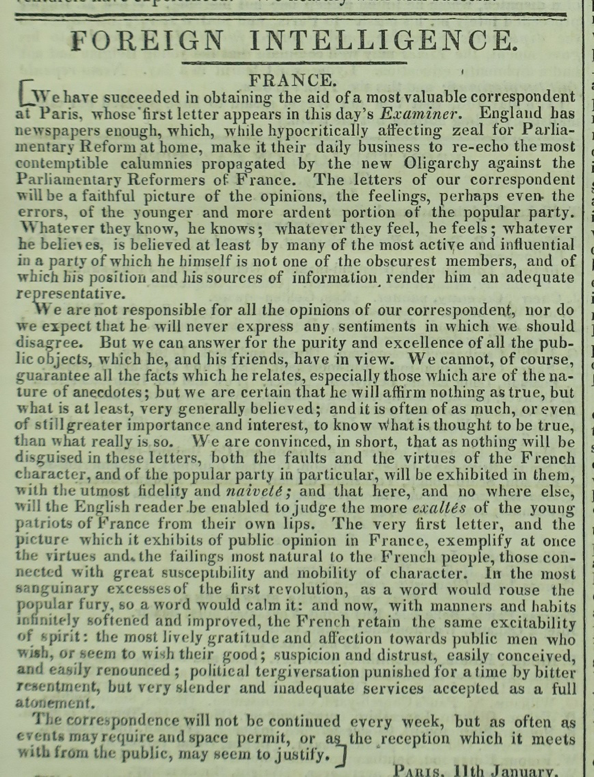
Similarly, in four of the five volumes, Mill has indicated the printed limits of the articles, themselves, by means of square brackets, as with this brief summary of “Foreign Intelligence” from p. 55 of this same volume:
He was quite obviously proud of his numerous contributions, which ranged from his series on “The Spirit of the Age” (which elicited Thomas Carlyle’s appreciation and became the basis for their friendship) to leading articles on French affairs to brief paragraph-length summaries of stories from other newspapers.
Once donated to Somerville, however, not all of these works were read with the same attention or intellectual priorities. Rather than favoring early editions of Mill’s major works, students appear to have read the last published editions, provided, of course, that they were printed in Britain. American editions of Mill’s books are virtually devoid of marginalia, even when printed more recently than their British counterparts. And rather than marking and annotating with an eye toward revision and later republication, students seem to have sought out Mill’s pronouncements on induction or free-market capitalism in order to acquire the basic ideas and/or dispute the major premises.
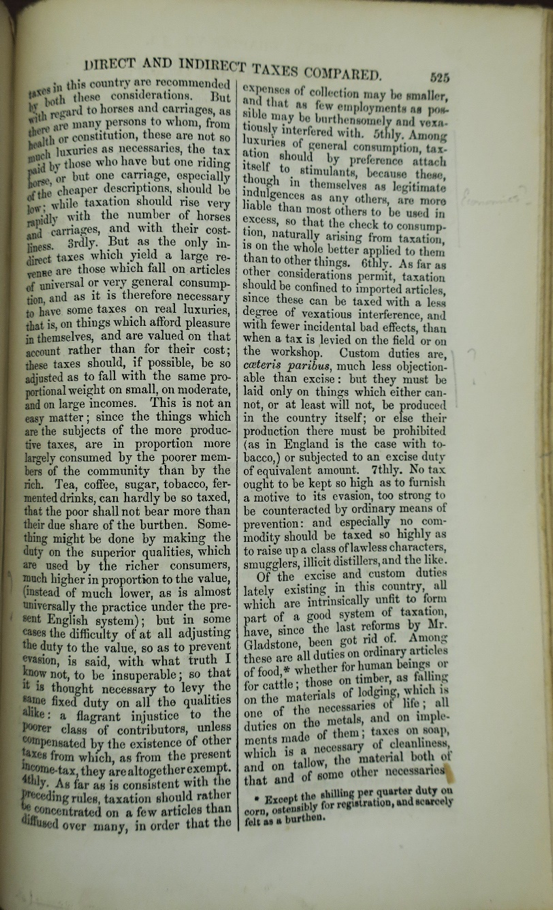
The posthumous one-volume cheap editions of both System and Principles show signs of especially significant student use, despite the fact that their two-column format, smaller typeface, and flimsier paper make them less easy to read than previous versions. For instance, dominated by scores of scores and a small army of marginal question marks, Principles moved one student to wonder about the text’s advice concerning taxation and the field of economics:
Whether this query was made in the era of Edward VII when the book was first donated or of George VI would be interesting to know, as “Economics?” would have meant rather different things before and after two world wars.
Mill’s periodical contributions, including his carefully documented newspaper articles, bear no obvious signs of being read by students at all. Which makes my work easier, of course, but which also makes me wonder whether and how contemporary scholars’ considerable output of articles, essays, occasional writing, and reviews (to say nothing of blog posts) might be read by students of the future.