Earlier this month, I was pleased to return to Somerville College to gather further data from the John Stuart Mill Collection and to present at the Annual John Stuart Mill Seminar.
Over the course of a week, I took 5480 photographs of just over 2000 individual pages in 224 volumes that, collectively, comprise 59 new titles for a future update of Mill Marginalia Online. With roughly 80% of the collection now photographed, the end of the project’s data collection phase is gradually coming into focus. I estimate that three more trips will be sufficient to capture images of all remaining pages with marginalia.
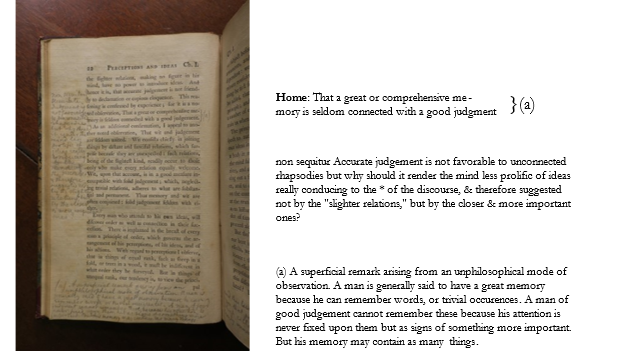
This year’s Annual Seminar featured introductory remarks highlighting the ongoing marginalia census being continued by Jane Macintyre, as well as papers from Dr. Jeremy Fix of Keble College, Somerville Emeritus Fellow Julie Jack, and myself. Philosophy was the unifying discipline this year, with Mill’s Utilitarian consequentialism contrasted with Kantian deontology as the basis for identifying moral agents and patients (Fix), his solution to Zeno’s paradox in the System of Logic (1843) reconnected with its Aristotelian roots (Jack), and Mill’s marginal responses to Henry Home, Lord Kames’s Elements of Criticism (1762) revealed for the first time and in the light of Mill’s subsequent publications on their shared subjects of perception, memory, and cognition (Pionke).
The following slide captures Mill’s generally critical reaction to Home’s Elements of Criticism:
Unmentioned by title anywhere in Mill’s published works, Home’s Elements nevertheless prompted Mill’s unpublished attention, which is, of course, precisely the point of digitizing his marginalia.
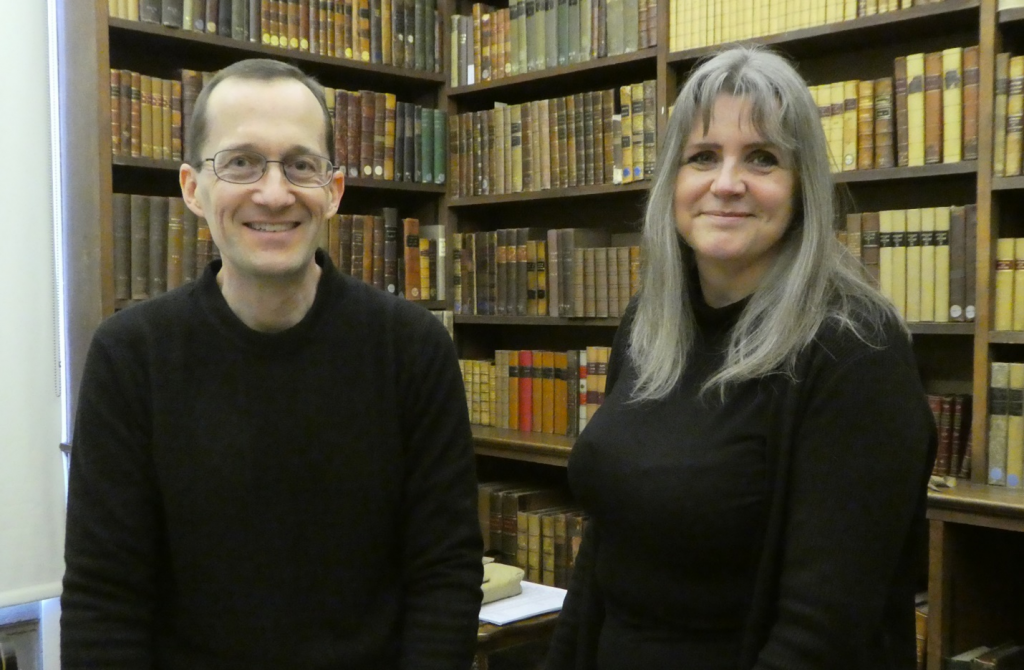
This effort at digitization gained a new collaborator in late 2022, as my longtime Oxford partner Anne Manuel retired and was succeeded by Sarah Butler as Somerville Librarian. We met for the first time in person in March, when Sarah organized the Annual Seminar, generously listened to my rhapsodies about the importance of nonverbal marks, and generally created a welcoming and productive atmosphere for a frenzy of photographic work. Here we are, taking a brief breather amidst Mill’s books:
Just beyond Sarah’s left arm are the works the Jules Michelet, the last author whose books I photographed on this March 2023 trip.
After over two years of work on three continents, much of it completed during a global pandemic, I am pleased to announce that the redesigned Mill Marginalia Online is now up and running.
The differences from a user’s perspective are subtle: a single button now allows anyone to download the project’s full metadata to date, rather than having to do so one book at a time; and critical introductions are now grouped together and accessible via button on the Home screen rather than pinned directly to their specifically associated Volume pages.
Behind the scenes, however, almost everything has changed. Newly rebuilt in WordPress, MMO no longer requires a resident code ninja to update and maintain, which fact has finally allowed the data set to return to growth.
The new site features a fresh 8000+ examples of marginalia, representing almost the entirety of Mill’s extensive Classics collection. There is also a new multi-part critical introduction to George Grote’s History of Greece, which is perhaps the most extensively annotated title in Somerville’s Mill Library. The now-26,000+ marks and annotations represent the roughly one-half of the total books remaining from Mill’s Blackheath library.
And there’s more on the way! Mill’s English books of literature, history, botany, and other subjects are currently being processed. Stay tuned to learn when you’ll be able to review on-the-page responses to Boswell, Bulwer-Lytton, Butler, Byron, and that’s just the B’s.
At long last, after three years’ absence, I was very pleased to return earlier this month to Somerville College, where I found the Mill Library serenely unchanged by either global pandemic or international conflict. Resuming my photographic collection of marginal data, I progressed from the east to the west side of the library’s south-facing window, thereby moving from the last remnants of ancient Greece into Mill’s collection of comparatively modern and to-him contemporary English literature. Over five days, under the benign glare of new studio lights, I took over 5500 photos of over 2500 pages in over 100 volumes, about which more in future postings.
I also joined Drs. Anne Manuel and Helen McCabe and Professors Menaka Philips and Roger Crisp in presenting at the Annual John Stuart Mill Seminar. Here, a heady mix of the evolving history of the management of the Mill collection, Mill’s complex relationship with a variety of pre-Marxian socialisms, his more recent role as “essential” (and also too-simplistic) referent for all things liberal, and an overview of ten newly acquired letters (most unknown to and therefore unpublished in the Collected Works) written by Mill between the 1830s and 1860s, was leavened by tea, biscuits, and cake.
My own presentation concerned Mill’s marginalia in his friend, George Grote’s History of Greece (1846-56). Comparing the individual pages featuring marginalia in Mill’s first-edition personal copy with the corresponding pages of all subsequent editions through the 1862 “new” edition, as well as the text of each of Mill’s annotations with the letters he wrote home to an ailing Harriet during his 1854-55 trip to Italy and Greece, I was able to approximate when and in what spirit Mill contributed his handwritten additions to Grote’s already-lengthy text. My findings, summarized in the following bullet points, reveal that Mill must have read and annotated volumes I-XI at least twice:
Firstly, after their 1st edition publication, [almost certainly prior to their review], and definitely before any revised editions
Vol. I & II: March 1846 – [April 1846] January 1849
Vol. III & IV: April 1847 – [June 1847] January 1849
Vol. V & VI: December 1848 – [March 1849] March 1851
Vol. VII-VIII: February 1850 – [March 1850] December 1851
Vol. IX-XI: February 1852 – [October 1853] March 1856
Secondly, after Mill’s trip to Italy Greece (December 1854 – June 1855), and before Grote’s proofs for the November 1862 edition
Incidentally, volume XII need only have been read once, after the March 1856 1st edition, since it appeared after Mill had returned from his trip (to which none of the marginalia in volume XII refers). In any case, in contrast to the earlier volumes, which feature nearly 150 textual emendations made in response to Mill’s generously offered editorial advice, Grote made no changes to his final volume in response to Mill’s marginalia, which he may or may not have ever seen.
Those interested in the data behind these findings may wish to read the new Critical Introduction to Grote’s History of Greece, co-authored by myself and my most recent RA, Riley Hines and forthcoming on Mill Marginalia Online in April (we hope). In the meantime, expect more marginal news in this space.
I am pleased to announce a fresh upload of data to Mill Marginalia Online. The roughly 2500 new examples of marginalia include all those found in the works of both James and John Stuart Mill. Most of these were clearly made by JSM himself, with an eye towards future republication, whether in Dissertations and Discussions or in subsequent editions of A System of Logic or Principles of Political Economy. Although nearly all are accurately noted in the University of Toronto Press’s edition of the Collected Works, being able to see Mill’s careful revision of his own prose in his own hand lends a certain immediacy and vitality to these moments of textual history.
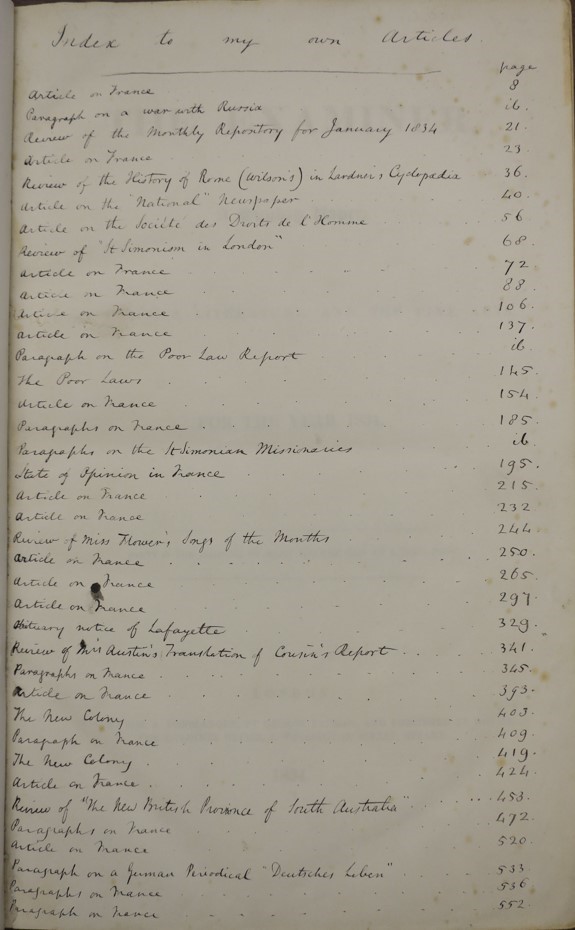
The front flyleaves of bound volumes of The Examiner from 1831, 1832, 1833, and 1834 provide a particularly clear example of Mill’s curatorial impulses towards his own publications, written in his most legible hand. The following appears in the 1834 volume:
Front flyleaf, The Examiner, 1834
Obviously proud of his relatively early work in the newspaper, Mill has gone out of his way to record every paragraph, notice, and article that he contributed. Some of the items listed seemed to him significant enough to revisit in the margins, and this latest set of images captures every copyedit, revision, renumbering, and doodle that he made.
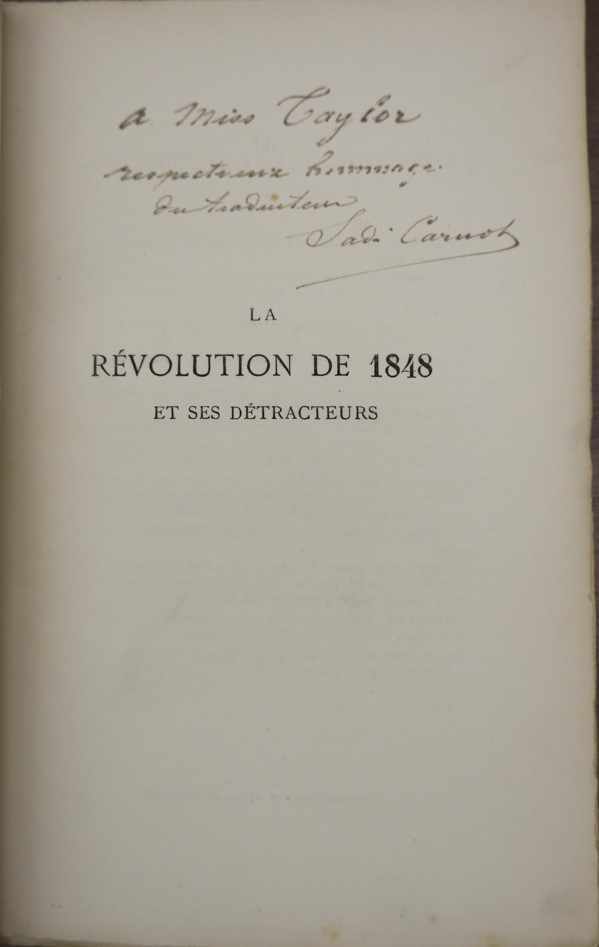
Also present are translations of Mill’s work in French, Italian, and German, most with inscriptions from their respective editors. These include volumes received after Mill’s death, at which point the inscriptions shifted their addressee to Helen Taylor, Mill’s stepdaughter, late-career amanuensis, and guardian of his intellectual legacy. See, for instance, the half-title page of Said Carnot’s 1875 French translation of La Révolution de 1848 et ses Détractures:
Half-title page, La Revolution de 1848 et ses Detractures
Most of the pages in this book remain uncut, indicating that for all Carnot’s “respectful homage,” Helen Taylor did not read it. She did, however, preserve it among Mill’s books, making it available for digitization today.
My thanks to Patrick Motley for his perseverance in uploading this new material, to Riley Hines for her meticulousness in looking over the data, to Kaitlin Wright for making the original transcriptions, and to everyone involved with the project for their patience and good humor in the midst of global anxiety.
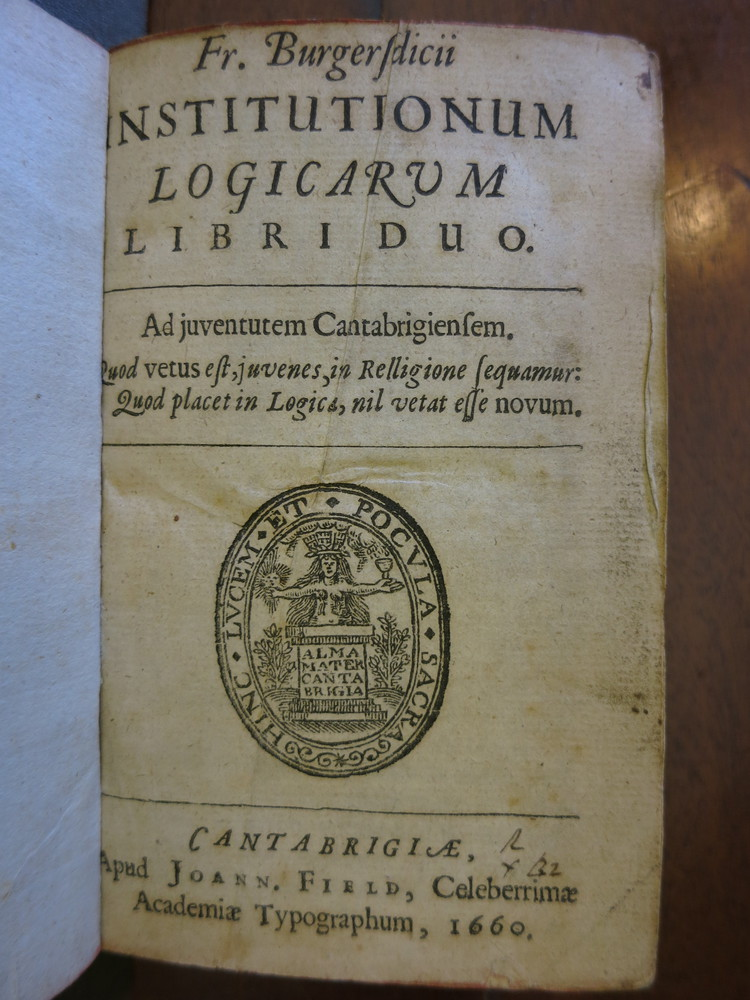
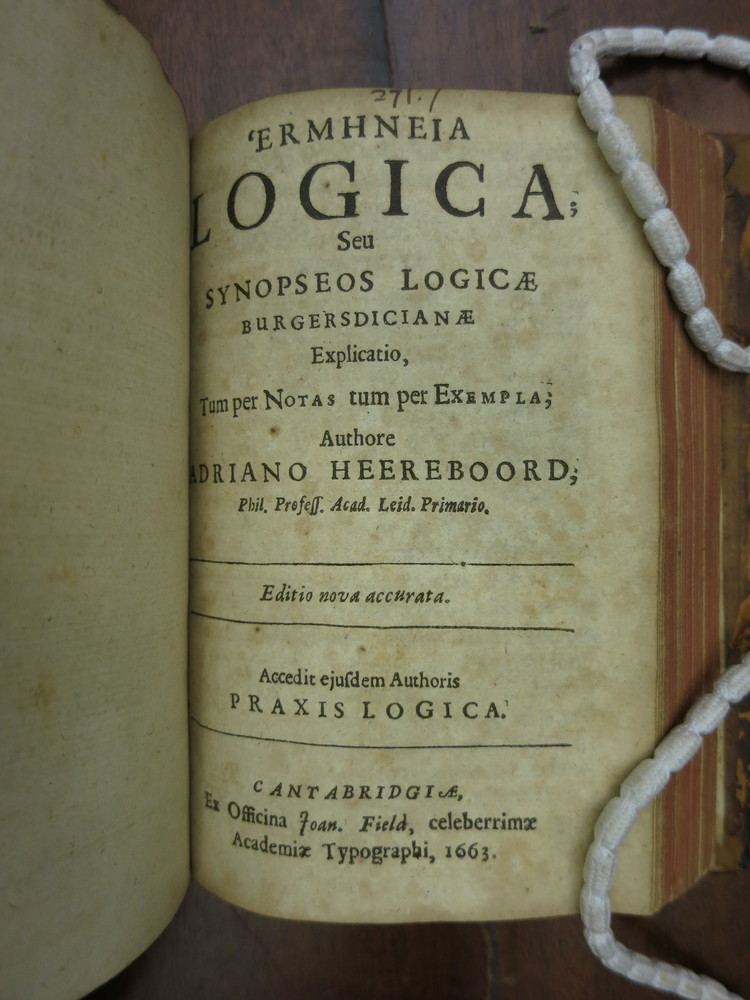
My third and final 2020 publication was co-authored with my co-PI, Emma Wilson, and appeared in a special issue of Nineteenth-Century Prose dedicated to Mill. It focused on the volume catalogued as Francis Burgersdicius’s Institutionum Logicarum, which is actually two books printed together, Dutch schoolman Franco Burgersdijk’s textbook Institutionum Logicarum, published in 1660, and his successor Adriaan Heereboord’s Hermēneia Logica, published in 1663:
Title Page of Franco Burgersdijk’s Insitutionum Logicarumtitle page of Adriaan Heereboord’s Hermeneia Logica
Each contains an independently paginated preface and main text, with Institutionum Logicarum featuring 24 pages of prefatory material and 357 pages of main text, while Hermēneia Logica offers 6 pages of prefatory material and 311 pages of main text. With roughly three-quarters of the collection now surveyed for handwritten additions, one half of which have been photographed, and one quarter transcribed and uploaded, I can say with some confidence that the book contains the second largest number of individual examples of marginalia of any single volume. In all, 351 of its pages contain at least one mark or annotation, with 1568 total instances.
Over one-third of this total is represented by 576 examples of neatly handwritten numerals. Some of these examples contain multiple numbers separated by periods, however; when these numerical chains are broken into their constituent links, the total quantity of marginal numbers increases to 611. These can be found in three of the four independently numbered sections of Institutiorum Logicarum: 21 in the first set of prefatory pages; 251 in Burgersdijk’s main text; and 339 in the main text of Heereboord. The numbers appear in two forms, with and without a decimal tenth added (i.e., 19 and 19.1). Since when multiple individual numbers appear together in the same annotation they are also separated by periods, this convention only added to the marginalia’s initial inscrutability.
Ultimately, Emma and I were able to discern that the more than 600 handwritten numbers in Burgersdijk’s Institutiorum Logicarum provide an elaborate system of marginal cross-references. Just under 95% (580 of 611) of all numerical annotations in the book lead one to corresponding annotations on the pages referenced by the original numbers. Numbers with a decimal tenth added to them lead one to pages in the other, independently paginated portion of the main text.
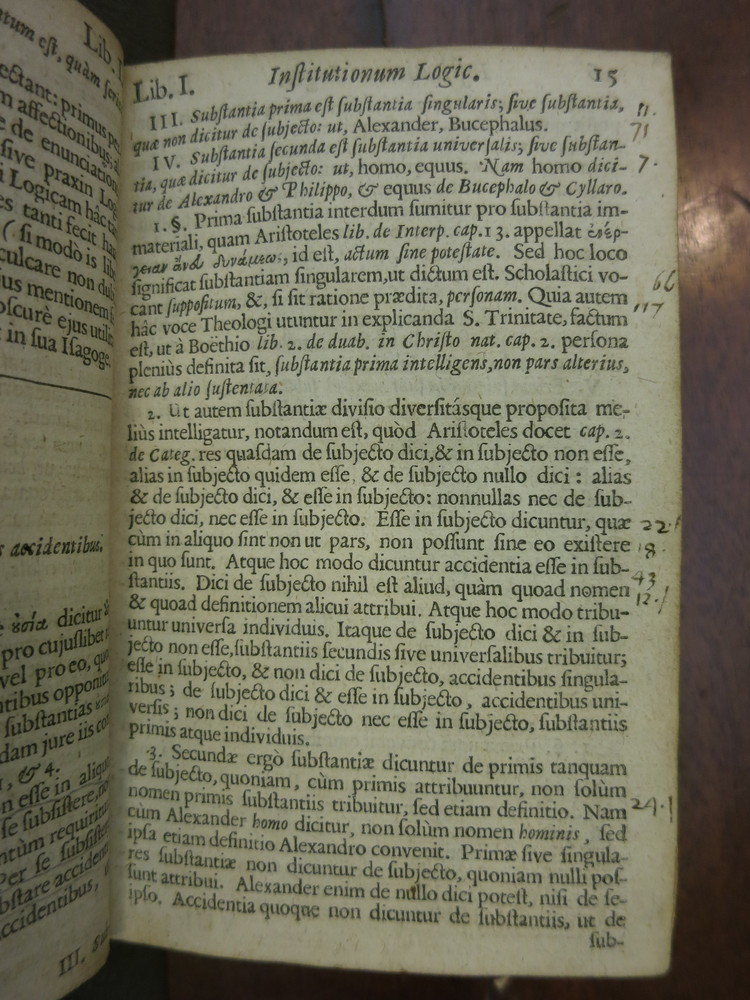
p. 15 of JS Mill’s personal copy of Burgersdijk, with hand-written numbers in outer margin
Thus, page 15 of part one, pictured above and authored by Burgersdijk, includes, from top to bottom, the handwritten numbers 11, 71, 7, 66, 117, 22.1, 18, 43, 12.1, and 24.1. Similarly, pages 11, 7, 66, 117, 18, and 43 of part one contain a handwritten “15” in the margin, whereas pages 22, 12, and 24 of part two, authored by Heereboord, all feature “15.1”; moreover, each of the pages referred to by page 15 also contains additional numbers that, on the basis of other subjects, lead one to further pages.
Of the remaining 31 numbers for which there are no apparent corresponding pairs, 21 appear in the prefatory pages of Burgersdijk’s half of the volume. Here, they provide page numbers, odd numbers only, in the top corner of pages that are otherwise only identified by their section headings (i.e., “Dedicatio” or “Præfatio ad Lectorem”), allowing for marginal cross references between these now-numbered early pages. Alas, the final ten numbers resisted all of our efforts to decode them.
Nevertheless, sorting out the function of 601 of the 611 marginal numbers allowed us to compare the printed text adjacent to Mill’s handwritten numbers, concentrating for the purposes of our article on those appearing in Burgersdijk’s half of the volume. In so doing, we discovered that, even in his tweens, Mill was already embarking on the intellectual trajectory that would ultimately result in his own System of Logic (1843). His marginal numbers allowed him to move quickly between, to cite only a few examples, 1) similar passages exhorting a sound logical education as the basis for the correct and upright running of a nation, 2) Burgersdijk’s hierarchical classification of logicians into a “first,” “second,” and “third” class, as well as other ways of structuring learning about logic, 3) the Dutchman’s definition of logic, 4) his enumeration of the four instruments of logic (definition, division, syllogism, and method), 5) his connection between the practice of logic and the development of lasting intellectual habits, and 6) his taxonomy of causes, including his differentiations between “proegumenic” and “procatarctic” causality.
Constructing this dense network of marginal numbers was, undoubtedly, an enormous amount of work. It is also work that would need to be done while the book was fresh in one’s mind, perhaps with the aid of now-lost handwritten notes, as the range of cross-references spans the entire volume, in 80 instances pointing out corresponding passages in the separate treatises written by Burgersdijk and Heereboord, respectively. Whenever the numbers were added—and this is a chronological detail that we are likely never to be able to pinpoint—they were a significant addition to a text already crowded with evidence for Mill’s close engagement and sustained dialogue.